Mar 7th 2026
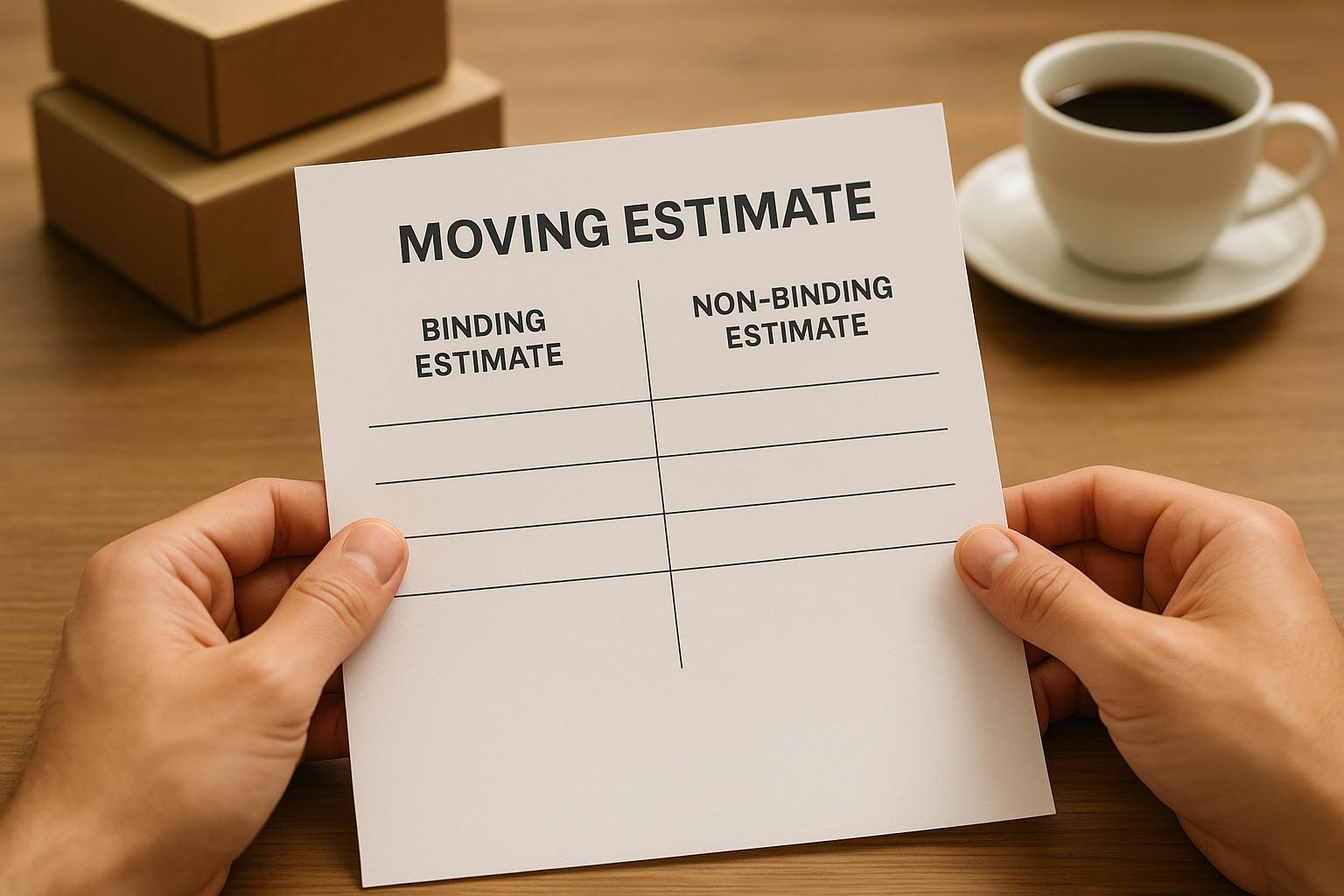
Ultimate Guide to Moving Estimates: Binding vs. Non-Binding
When planning a move, understanding the two main types of moving estimates - binding and non-binding - is crucial to managing your budget and avoiding surprises. Here’s a quick breakdown:
- Binding Estimates: Offer a fixed price based on an agreed inventory and services. Great for predictability, but adjustments require updates to the estimate.
- Non-Binding Estimates: Provide flexibility, as the final cost is based on the actual weight of your belongings. However, this means the price can increase, though federal rules cap it at 110% of the estimate for interstate moves.
Both options have pros and cons. Binding estimates are ideal if you want cost certainty, while non-binding estimates work better if your inventory might change or you’re downsizing. Choose based on your priorities: stability or flexibility.
Quick Comparison
| Feature | Binding Estimate | Non-Binding Estimate |
|---|---|---|
| Price Guarantee | Fixed unless inventory/services change | Adjusts based on actual weight/services |
| Budget Certainty | High | Low |
| Flexibility | Limited | High |
| Risk of Extra Costs | Low | Higher (capped at 110% for delivery) |
| Best For | Predictable moves with fixed inventory | Changing inventories or potential savings |
Choose the type of estimate that aligns with your moving needs and budget. For added security, work with reputable movers and ensure all terms are clearly documented.
Binding Estimates: Fixed Prices You Can Count On
What Is a Binding Estimate?
A binding estimate is a written contract that sets your moving costs at a fixed price based on the inventory and services you specify. This agreement ensures the quoted price won’t change - as long as your inventory and service requirements stay the same as what you initially provided. However, if you add more items or request additional services, the final cost may be adjusted. Let’s explore when opting for a binding estimate makes the most sense.
Non-Binding Estimates: Flexible Pricing with Some Risk
What Is a Non-Binding Estimate?
A non-binding estimate gives you an approximate idea of your moving costs, but it’s not set in stone. Unlike binding estimates, this type of quote can fluctuate based on factors like the actual weight of your belongings, the services you use, and the mover’s official pricing structure.
Here’s how it works: movers weigh the truck both before and after loading your items. The difference in weight determines your final bill. If your shipment weighs more than expected or the job requires additional labor, your total cost will go up.
There are a few key rules for non-binding estimates. They must be provided in writing, be reasonably accurate, and clearly outline all household items and services involved. If anything changes during the move, the mover is obligated to either update the estimate or confirm the original terms in writing.
While this approach offers flexibility, it also comes with some unpredictability, making it important to weigh when this option might make sense for your situation.
When to Consider a Non-Binding Estimate
Deciding on the right type of estimate can help you manage moving costs effectively. Non-binding estimates are particularly useful when your inventory is likely to change before moving day. For example, if you’re still sorting through what to take and what to leave behind, this type of estimate can adapt to those changes.
This option is especially helpful for those downsizing. If you’re moving from a larger home to a smaller one, your actual shipment might weigh less than initially estimated, giving you a chance to save money.
One of the biggest perks of a non-binding estimate is its potential for cost savings. If the actual weight of your items is less than expected, you’ll pay less than the original quote. It also makes comparing quotes from different movers easier.
However, flexibility comes with a trade-off. Non-binding estimates provide less budget certainty, which means you might end up paying more than anticipated. To avoid surprises, it’s important to have extra funds set aside just in case.
Rules and Limits for Non-Binding Estimates
Federal regulations include specific protections for consumers using non-binding estimates. One of the most critical protections is the 110% rule, as explained by the Federal Motor Carrier Safety Administration (FMCSA):
"Under a nonbinding estimate, the moving company cannot require you to pay more than 110 percent of the non-binding estimate at the time of delivery."
– FMCSA
This rule acts as a financial safeguard. For example, if your estimate is $3,000, the mover cannot demand more than $3,300 at the time of delivery - even if the final charges exceed that amount. Any additional costs beyond the 110% limit will be billed after delivery.
But what if you can’t pay the required amount at delivery? In that case, your belongings may be placed in storage, and you’ll be responsible for the storage fees. This highlights the importance of planning for the potential maximum cost when budgeting for your move.
When dealing with non-binding estimates, always insist on having everything documented in writing. Make sure the estimate is thorough and complete before signing, and work with reputable movers who can provide accurate weight estimates. Preparing for the highest possible cost ensures you won’t be caught off guard on moving day.
Your Guide to Moving Estimates: Binding vs. Non-Binding | Bailey's Moving and Storage

sbb-itb-be87134
Binding vs. Non-Binding: Side-by-Side Comparison
Knowing the differences between binding and non-binding estimates can help you make the right choice for your move. Each option has its own advantages and drawbacks, so your decision will likely depend on what matters most to you: price stability or flexibility.
If you prefer a set price with no surprises, binding estimates are the way to go. On the other hand, non-binding estimates work better if you want the chance to save money when your shipment weighs less than expected or if you need room to adjust your inventory.
Federal rules mainly apply to interstate moves [2]. For local moves, state or local regulations come into play, though the basic principles of binding and non-binding estimates remain the same [1]. The table below highlights the key differences for quick reference.
Comparison Chart: Binding vs. Non-Binding Estimates
| Feature | Binding Estimate | Non-Binding Estimate |
|---|---|---|
| Price Guarantee | Fixed price unless you add items or services [1][4][2] | Estimated price; final cost depends on actual weight and services [1][4][2] |
| Budget Predictability | High: You’ll know the total cost upfront [1][4] | Low: Final cost may exceed the estimate, complicating budgeting [1][4] |
| Flexibility | Limited: Adding items or services requires a revised estimate, and movers can refuse service if terms aren’t updated [1] | High: You can add or remove items/services, with costs adjusting accordingly [1][4] |
| Risk of Extra Charges | Low, as long as inventory and services match the agreement; extra charges may apply for unexpected complications (e.g., stairs, long carries) [1][2] | Higher: Costs can exceed the estimate, though movers can’t demand more than 110% of the original quote at delivery for interstate moves [1][2] |
| Payment at Delivery | Full payment is required at delivery for interstate moves, per FMCSA rules [1][2] | FMCSA rules cap payment at 110% of the estimate at delivery for interstate moves [1][2] |
| Best Use Cases | Ideal if you want a guaranteed price and have a clear inventory; great for large households or peak-season moves to avoid surprises [1][4] | Best for those with changing inventories, those considering additional services, or those hoping to save if the shipment weighs less than estimated [1][4] |
Choosing the Right Estimate for Your Move
Go with a binding estimate if you want a locked-in price, have an accurate inventory, or are moving during a time when rates might fluctuate. It's also a smart choice if your items need special handling, and you want to avoid unexpected costs [1][4].
Opt for a non-binding estimate if your inventory could change (e.g., downsizing before moving day), you're working with a reliable moving company, or you're open to saving money if your shipment weighs less than expected [1][4].
Binding estimates provide price certainty, while non-binding ones allow flexibility based on actual shipment weight. The 110% rule offers protection with non-binding estimates, ensuring movers can’t demand excessive payments at delivery while still accounting for weight and service adjustments. Use this guide to decide which option best fits your moving needs.
How to Choose the Right Estimate for Your Move
Binding estimates offer a fixed price, while non-binding estimates provide more flexibility. The right choice depends on how stable your inventory is, your budget, and the reliability of your mover. Let’s break down how to decide.
Review Your Inventory and Budget
Start by taking a close look at your inventory. Binding estimates lock in a set price based on a fixed list of items [5]. Walk through your home and make a detailed list of everything you’re planning to move.
Keep in mind that movers typically won’t transport hazardous materials, perishables, plants, pets, or very high-value items. It’s a good idea to confirm any restrictions directly with your moving company.
If your inventory is finalized and unlikely to change, a binding estimate ensures cost predictability. However, if you're still deciding what to take or expect changes, a non-binding estimate might be more suitable. Just remember, with non-binding estimates, the final cost could increase.
Choose Movers You Can Trust
Once you’ve clarified your inventory and budget, focus on finding a reliable mover. Look for companies that offer clear, itemized pricing to help you compare estimates and plan your budget effectively [5].
Platforms like ConsumersAdvisors.com can be a helpful resource. They provide instant moving quotes, expert reviews, and detailed information about licensed movers, including options for full-service packing and storage.
When comparing movers, prioritize transparency. Look for companies that clearly explain their binding and non-binding estimate policies, provide detailed pricing breakdowns, and avoid hidden fees.
And don’t just go for the cheapest option. A reputable mover with proper licensing and clear communication about their services is often a better choice for a smooth and stress-free move.
Making the Right Choice for Your Move
Choosing between binding and non-binding estimates depends on what matters most to you - certainty, flexibility, or cost control. Both options have their advantages, and understanding how they work can help you make a well-informed decision.
Binding estimates are perfect if you need a firm price and have a clear, fixed inventory. They’re especially helpful during busy moving seasons when sticking to a budget is critical. However, it’s important to include every item in the initial inventory. Adding items later will require a revised estimate, and you’ll still be responsible for the full quoted price - even if the actual weight turns out to be lower. Keep in mind, reductions in weight won’t lower the cost once the estimate is set.
On the other hand, non-binding estimates offer more flexibility but come with some financial uncertainty. These are better suited for moves where your inventory might change, such as downsizing or decluttering. If your actual weight is less than the estimate, you could save money. However, there’s a catch: your final bill can legally go up to 110% of the original estimate. For example, a $3,000 estimate could climb to $3,300, which might complicate budgeting - especially for long-distance moves, where costs are usually higher [1].
There’s also a third option to consider: the "not-to-exceed" estimate. This type of estimate gives you a maximum price cap while still allowing you to pay less if your actual weight is lower than expected [6]. It’s a good middle ground, combining the cost certainty of binding estimates with the potential savings of non-binding ones.
When you’re ready to compare estimates, platforms like ConsumersAdvisors.com can connect you with licensed movers who provide clear pricing and explain their policies in detail. Their network includes companies offering both binding and non-binding options, backed by expert reviews to help you find a trustworthy mover.
It’s also reassuring to know that the Federal Motor Carrier Safety Administration (FMCSA) oversees these types of estimates to protect consumers [1] [3]. Look for movers who are transparent about their policies, provide thorough inventory lists, and have a proven track record of fair pricing. These steps can help ensure a smoother moving experience.
FAQs
What should I consider when choosing between a binding and non-binding moving estimate?
When deciding between a binding and non-binding moving estimate, it’s important to weigh your budget needs and how much flexibility you’re comfortable with. A binding estimate locks in a fixed price based on your inventory. This means no surprises - what you’re quoted is what you’ll pay. It’s a great option if you value cost certainty and want to avoid unexpected charges.
A non-binding estimate, however, is based on the estimated weight of your belongings. While it might seem appealing at first, the final cost can change. If your items weigh more than anticipated, you’ll end up paying more. On the flip side, if your shipment is lighter, you could save money. This approach works well if you’re okay with some price fluctuation and are looking for potential savings.
Ultimately, the choice comes down to your priorities: do you prefer a predictable price or the possibility of flexibility?
What is the 110% rule, and how does it protect me with a non-binding moving estimate?
When you're using a non-binding estimate for an interstate move, the 110% rule acts as a safeguard against unexpected delivery overcharges. This rule limits what the mover can demand at the time of delivery to no more than 110% of the original estimate, even if the actual costs turn out to be higher.
That said, any additional charges beyond this 110% cap can still be billed to you later. This approach helps manage upfront costs, giving you some breathing room to handle any extra fees after your move is complete.
When is a 'not-to-exceed' estimate a better choice than binding or non-binding estimates?
A 'not-to-exceed' estimate, also known as a 'guaranteed not-to-exceed' estimate, offers a solid balance of cost control and flexibility. Essentially, it sets a maximum price cap for your move, ensuring you’ll never pay more than the agreed-upon amount. And here’s the bonus: if the actual moving costs come in lower than expected, you only pay the reduced total.
This type of estimate is particularly helpful for long-distance moves, where costs can vary based on factors like weight or distance. It gives you financial predictability while still leaving room for potential savings. If you’re worried about surprise price hikes, a 'not-to-exceed' estimate can provide the security you’re looking for while keeping things fair.