Oct 2nd 2025

5 Ways To Verify Moving Company Credentials
Choosing the wrong moving company can lead to financial, legal, and property risks. To avoid scams and ensure a safe move, always verify a mover's credentials. Here's how:
- Check Federal Licenses (FMCSA): For interstate moves, confirm the company has a valid U.S. DOT number and proper insurance via FMCSA tools.
- Verify State Licenses: For local moves, check the state’s regulatory agency to ensure the mover complies with licensing and insurance rules.
- Confirm Insurance Coverage: Request a Certificate of Insurance (COI) and verify it directly with the insurer.
- Review Safety Ratings and Complaints: Use FMCSA’s SAFER system and consumer feedback to assess the mover’s performance and reliability.
- Get Written Estimates: Obtain detailed, written quotes from multiple companies to avoid hidden fees or scams.
Quick Tip: If a company refuses to share licensing details or provide a written estimate, it’s a red flag. Always verify credentials before hiring.
Safeguard Your Move: Insights from a Moving Industry Pro
1. Check Federal Licenses via the FMCSA
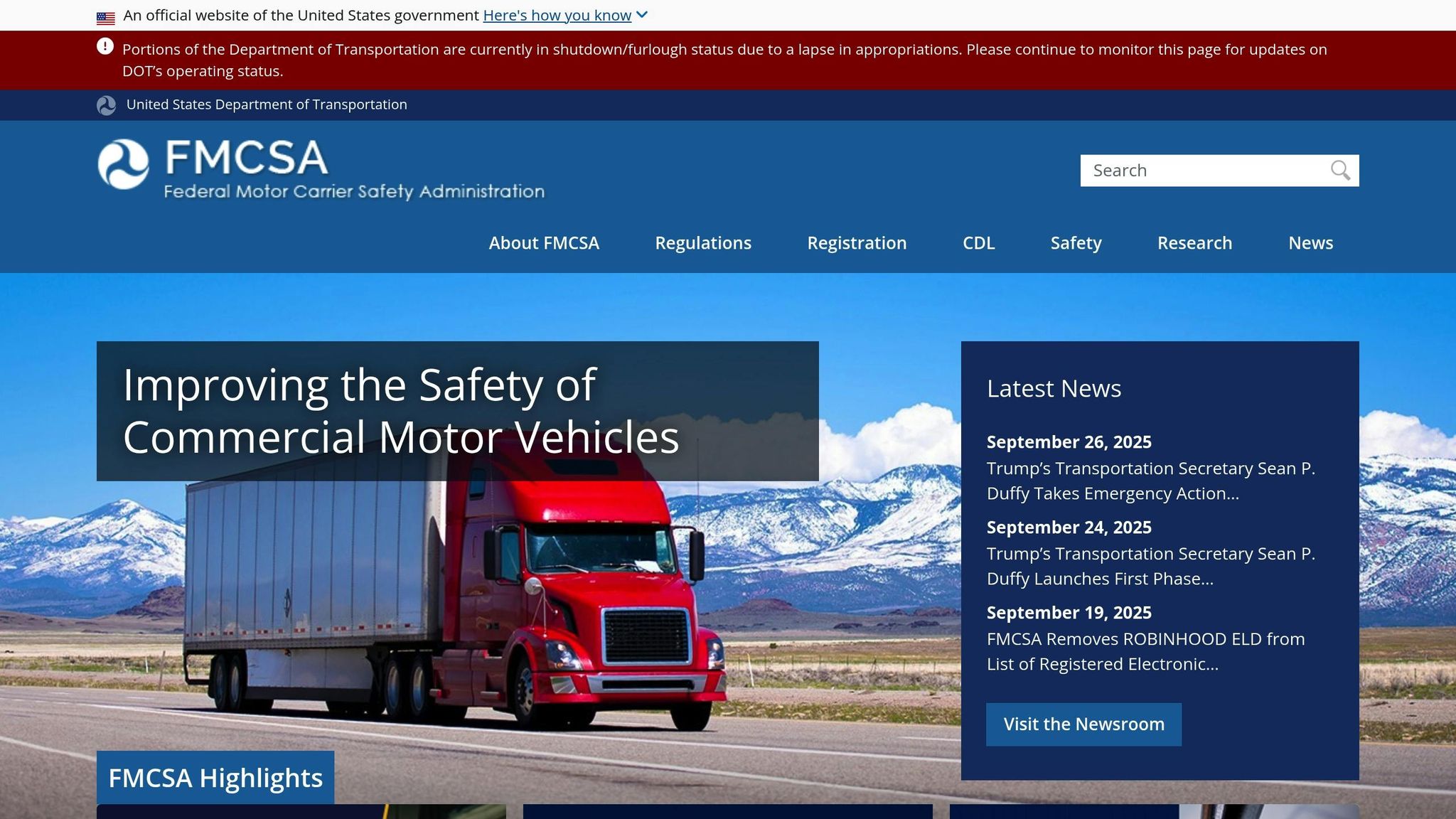
If you're planning an interstate move, the Federal Motor Carrier Safety Administration (FMCSA) is your go-to resource to avoid fraudulent movers. Any legitimate interstate moving company must be registered with the federal government and have a U.S. DOT number [1][3]. This isn't optional - it's a mandatory requirement. Before moving forward, use FMCSA's tools to verify these details.
The FMCSA provides two online tools to help you confirm a mover's credentials. The "Search for a Registered Mover" tool (fmcsa.dot.gov/protect-your-move/search-mover) and the SAFER Company Snapshot (safer.fmcsa.dot.gov/CompanySnapshot.aspx) allow you to search by U.S. DOT number, MC/MX number, or company name [1][2][4].
License Validity and Compliance
When reviewing a company's FMCSA record, pay attention to specific details. Their operating status should read "Authorized for HHG" (household goods) or "Authorized for Property." If it shows "Not Authorized" or "Pending," that's a serious red flag [4][5].
Legitimate movers must consistently display their U.S. DOT number (a 6–7-digit identifier) and MC number (formatted as MC-XXXXXX) on all materials, including contracts and advertisements. If you notice any discrepancies, it could signal licensing problems [1][5][7].
The FMCSA database also identifies the business type - whether it's a carrier (physically moves your belongings), a broker (arranges moves), or a freight forwarder. Understanding this distinction can clarify how your move will be handled [1].
Insurance Coverage and Documentation
The FMCSA database also confirms whether a mover meets federal insurance requirements. Look for evidence of minimum liability coverage of $750,000, cargo insurance, and a $75,000 bond [5][6]. These coverages protect your property from damage and ensure compensation if the company fails to fulfill its contractual obligations.
Safety Ratings and Complaint History
FMCSA records include safety ratings, which give you a snapshot of a mover's performance. A "Satisfactory" rating is a good sign, while "Not Rated" is acceptable for newer companies. However, steer clear of movers with "Conditional" or "Unsatisfactory" ratings [5][7].
Beyond ratings, the FMCSA database provides complaint histories, inspection summaries, and crash data from the last two years [1][7][8]. The SMS (Safety Measurement System) data compiles these details, and frequent out-of-service violations can indicate poor safety practices or inadequate maintenance.
2. Verify State Licenses for Local Moves
When it comes to local moves - those within a single state - the rules are different from interstate moves, which are federally regulated. Local movers operate under state-specific laws and licensing requirements, and these can vary widely depending on where you live [12].
As MyMovingJourney explains:
"Local movers are companies that handle moves within a single state. These movers are regulated by state agencies, and each state has its own licensing rules." [12]
The first step in verifying a mover's credentials is identifying your state’s regulatory agency. This is often the Department of Transportation (DOT), Consumer Affairs, or the Public Utilities Commission [10][12]. Once you know the agency, you can confirm the mover’s licensing and compliance.
License Validity and Compliance
To ensure your mover is legitimate, start by requesting their state-issued license number [12]. Many state agencies provide online tools that make license verification straightforward. Look for a feature like "License Search" or "Find a Moving Company" on your state’s regulatory website. You can usually search by the company name or license number [11].
When you check the results, focus on the license status. Common statuses include "Current", "Delinquent", "Revoked", or "Suspended" [9]. Only companies with an active and current license should be considered.
For instance, in California, local moving companies are regulated by the Bureau of Household Goods and Services (BHGS), which operates under the California Public Utilities Commission. Consumers can visit the BHGS website (https://bhgs.dca.ca.gov/) and use the "License Search" tool to confirm a mover’s credentials. For example, CareMore Moving & Storage is listed with Carrier ID MTR0190970 and an "Active" status, as verified through the BHGS database [11].
Each state has its own process. In Texas, for example, the Texas Department of Motor Vehicles (TxDMV) oversees local movers [12]. This highlights why it’s essential to research your state’s specific requirements.
Insurance Coverage and Documentation
Verifying a mover’s license goes hand in hand with checking their insurance coverage. Most states require movers to carry liability and cargo insurance. Ask for copies of their license and registration documents, and double-check that the business name and address match [12]. Any inconsistencies could be a red flag for licensing issues or even fraud. If online tools don’t provide enough detail, contact your state’s regulatory agency directly [11].
MOD24 emphasizes this point:
"For local moves, companies need state-issued permits. You can check with your state's transportation or public utilities agency for details." [10]
Operating without proper state licensing violates regulations. If you find out a mover doesn’t meet the required standards, report them to your state’s Department of Transportation or Consumer Affairs [12].
3. Confirm Insurance Coverage and Limits
When hiring a moving company, it's crucial to ensure they have proper insurance to cover their operations and safeguard your belongings. Double-check that the insurance limits align with the potential risks of your move to avoid unexpected expenses.
Insurance Coverage and Documentation
A trustworthy moving company should carry several types of insurance. These typically include general liability for property damage and injuries, workers' compensation for employee-related injuries, commercial auto liability for vehicle-related incidents, and cargo or inland marine insurance to protect your items during transit [13].
To verify this, always request a Certificate of Insurance (COI) when booking your move. This document outlines the company's insurance details, including policy limits and effective dates. Once you have the COI, contact the insurer directly to confirm the policy is active. As AJ Schneider from Olympia Moving & Storage highlights:
"If a moving company can't provide a certificate of insurance, that means that they're not insured! That would definitely be a red flag that you are not dealing with a professional moving company!" [13]
The COI should clearly list the moving company's name, contact details, insurance provider information, and specifics about the coverage. Confirming this information with the insurer ensures the policy is legitimate and provides the stated protections [13].
Valuation Coverage: Protecting Your Belongings
Beyond basic liability, moving companies often offer valuation coverage to outline their responsibility for lost or damaged items. While not technically insurance, it’s an important layer of protection. For interstate moves, you’ll typically have two options: Full Value Protection and Released Value Protection [14].
- Released Value Protection: This is the default option and comes at no additional cost. However, it only compensates $0.60 per pound per item. For example, if a 5-pound laptop worth $1,200 is damaged, you’d receive just $3. Similarly, a 400-pound piano valued at $8,000 would result in only $240 in compensation [16].
- Full Value Protection: This option costs more - usually 1% to 2% of your declared shipment value - but it holds the mover liable for the full replacement or repair cost of any lost or damaged items [14]. Unless you specifically opt for Released Value Protection in writing, this is typically the default for interstate moves.
For high-value items, consider listing them separately and confirming coverage limits with your mover [15]. Keep in mind that your homeowner’s or renter’s insurance typically won’t cover damages while your belongings are in the mover’s possession [14].
Coverage Options at a Glance
Here’s a quick comparison of the available coverage types to help you decide:
| Coverage Type | Cost | Compensation | Best For |
|---|---|---|---|
| Released Value Protection | No additional charge | $0.60 per pound per item | Budget moves with minimal valuables |
| Full Value Protection | 1–2% of declared value | Replacement or repair value | Most household moves |
| Third-Party Insurance | 1–5% of coverage limit | Full replacement cost | High-value items, luxury goods |
Why Proper Coverage Matters
One Pittsburgh family learned the importance of proper coverage the hard way when their leather sectional was damaged during a move, leaving them with steep repair bills [16]. As Don Farr Moving & Storage points out:
"A small investment in proper insurance coverage can prevent significant financial loss and stress during your relocation." [16]
If your belongings are damaged, file any claims within nine months of delivery. Additionally, be cautious when signing delivery receipts - strike out any language that might release the mover from liability before signing [15].
sbb-itb-be87134
4. Check Safety Ratings and Complaint Records
Safety Ratings and Complaint History
The Federal Motor Carrier Safety Administration (FMCSA) provides tools to help you assess a moving company's safety record and overall performance. Start with the SAFER System, which gives you a snapshot of a mover's details, such as fleet size, inspection summaries, crash history, and safety ratings. You can search by the company’s name, USDOT number, or Motor Carrier (MC) number.
For a deeper dive, check out the Safety Measurement System (SMS) website. This tool analyzes data from roadside inspections, crash reports from the past two years, and investigation records to identify carriers that might pose higher risks. As of August 29, 2025, all SMS data is up to date, with the next update set for the week of October 6, 2025 [17][18]. The SMS evaluates carriers based on seven categories, called Behavior Analysis and Safety Improvement Categories (BASICs). However, due to the FAST Act of 2015, some metrics - like the Crash Indicator and Hazardous Materials Compliance BASICs - are not publicly available for property carriers. That said, you can still access inspection, crash, and investigation data [17].
If you need more detailed information, you can request a Company Safety Profile through the FMCSA Portal or submit a Freedom of Information Act (FOIA) request [7].
Understanding Complaint Patterns
Safety ratings are important, but consumer complaints can provide a clearer picture of how a moving company actually operates. Pay close attention to patterns in complaints that might signal unreliable or untrustworthy service. For instance, pricing issues are a common red flag. Be cautious of companies offering low initial estimates that later balloon to charges exceeding 110% of non-binding estimates or surprise fees not mentioned in the contract [19].
Another major warning sign is when a mover refuses to release your belongings until you pay additional, unexpected fees. Fraud cases have risen by 35% since 2024, with victims losing an average of $2,800 [20]. Other frequent complaints include damaged or lost items, major delays, unprofessional behavior, and deceptive practices like bait-and-switch tactics or inaccurate weight estimates. Back in 2012, the FMCSA logged over 3,100 complaints about household goods movers - an increase from 2,851 in 2011. These complaints often involved shipments being held hostage, unauthorized moves, and dishonest practices [21].
Where to Research Complaint Records
Combining FMCSA data with consumer feedback offers a more complete view of a moving company's reliability. To start, use the FMCSA National Consumer Complaint Database. By searching with the company’s USDOT or MC number, you can access detailed complaint records from the past three years.
The Better Business Bureau (BBB) is another valuable resource, as it tracks formal complaints and their resolution status. Additionally, independent platforms like Google, Yelp, and Trustpilot host customer reviews that can provide useful insights. Pay special attention to reviews in the middle range (2 to 4 stars), as they often give a more balanced perspective. Be wary if a company has only glowing reviews - most reputable businesses will have at least some negative feedback. For extra peace of mind, try a quick Google search with the company’s name and terms like "scam", "lawsuit", or "complaint" to uncover any concerning information.
If you have questions or need to report a suspicious moving company, you can contact the FMCSA Information Line at 800‑832‑5660 or 1‑888‑DOT‑SAFT.
5. Review Online Feedback and Written Estimates
Reputation through Customer Reviews
Checking online reviews is a key step in evaluating a mover's reputation. Platforms like Google, Yelp, and the Better Business Bureau (BBB) provide valuable insights into customer experiences. Top-tier moving companies often have a BBB rating of A or higher and average at least 4.0 stars on Google and Yelp[25].
When reading reviews, focus on specific details rather than vague compliments. Look for mentions of staff names, move dates, and how the company handled any challenges. Positive reviews often highlight professionalism, punctuality, and clear communication, while recurring complaints typically involve damaged items or poor customer service[24]. Comparing reviews across multiple platforms can help spot inconsistencies or unusual patterns that might indicate fake feedback.
In 2022, the Federal Motor Carrier Safety Administration (FMCSA) received over 4,000 complaints about moving companies. Frequent issues included overcharging, lost items, and companies withholding belongings[24]. Additionally, the BBB reported that moving scams cost U.S. consumers more than $1.2 million that year, with victims losing an average of over $2,000 each[24].
While reviews provide a snapshot of service quality, written estimates offer clarity on costs.
Transparency in Written Estimates
A trustworthy moving company will always provide a written estimate, not just a verbal quote. This document should include the company’s full legal name, address, license numbers (such as USDOT and state licenses), and a detailed inventory of the items being moved.
Understanding the type of estimate you’re given is critical. As ConsumersAdvisors.com explains:
"A binding estimate locks in your price based on the estimated weight and services. A non-binding estimate can change if your actual load is heavier or takes more time"[22].
Here’s a breakdown of estimate types to help you understand your options:
| Estimate Type | Price Certainty | When Price Can Change | Best For |
|---|---|---|---|
| Binding | Fixed price | Price is locked and won’t exceed the estimate | Customers who want cost predictability |
| Non-binding | Variable price | May increase based on actual weight or time | Customers with flexible move plans |
A detailed, written estimate protects you from common scams, such as lowball quotes that suddenly skyrocket on moving day. It should clearly outline all costs, including labor, materials, travel time, and any extra fees. Companies that provide transparent, itemized pricing are more likely to be reliable.
Be cautious of red flags in estimates, such as missing company details, no physical address, or demands for large upfront deposits. Many scams involve companies offering suspiciously low quotes over the phone or online, only to inflate the price later[25].
Avoid companies that refuse to provide written estimates or pressure you into making quick decisions. Platforms like ConsumersAdvisors.com can simplify the process by offering pre-screened lists of licensed and insured movers, along with detailed reviews. These tools make it easier to compare pricing and spot trustworthy companies.
For the best results, collect written estimates from at least three different movers. This will help you gauge fair pricing and identify any outliers. If an estimate or review raises concerns, reach out to the company for clarification in writing. If they’re unresponsive or evasive, that’s a strong indicator to take your business elsewhere.
Comparison Table
Licensing requirements vary depending on the jurisdiction. Federal licensing applies to interstate moves, while state licensing governs local moves. Each system comes with its own set of rules and costs.
| Feature | Federal (Interstate Moves) | State (Intrastate/Local Moves) |
|---|---|---|
| Regulatory Body | Federal Motor Carrier Safety Administration (FMCSA) [26][27][28][29] | State Departments of Transportation, Public Utility Commissions, or state consumer affairs branches [26][27][28] |
| Scope of Operation | Covers moves that cross state lines [26][27][28][29] | Applies to moves that begin and end within the same state [26][27][28] |
| Primary License/ID | USDOT Number [6][26][27][28][29], Operating Authority (MC Number) [28][29] | State-specific licenses [26][27][28]; some states (e.g., New York) may also require a USDOT Number [28] |
| Purpose of License | Ensures compliance with federal safety regulations, tracks safety data, and authorizes for-hire interstate transport of federally regulated goods [26][28][29] | Ensures compliance with state laws, consumer protection rules, and state-specific safety regulations [26][27] |
| Application Costs | USDOT Number: ~$99, MC Number: ~$399 [28] | Varies by state |
| Insurance Requirements | Proof of insurance and bonding required for federal operating authority [28][29] | Requirements vary; some states mandate cargo insurance, while others may not. General business insurance and a $75,000 surety bond are common requirements [27][28] |
| Key Legislation | Household Goods Motor Carrier Act [26] | State-specific laws and consumer protection regulations [26][27] |
It’s important to note that FMCSA registration is different from operating authority. For example, brokers - who arrange moves but don’t handle goods - have separate requirements [6][27].
To ensure a safe move, always verify credentials. Use the FMCSA database for interstate moves and your state’s regulatory site for local ones. Some states, like New York, require both federal and state licensing [28]. This dual system is designed to protect consumers at multiple levels: federal oversight focuses on safety for interstate moves, while state regulations address local consumer protection concerns [26]. By understanding these distinctions, you can better navigate the licensing landscape and ensure compliance for your move.
Conclusion
Checking a mover's credentials is a crucial step to avoid scams and poor service. By taking the time to verify, you can protect yourself from potential headaches during your move.
In 2023 alone, over 4,000 complaints were filed against moving companies, with scams costing consumers millions of dollars. On average, victims lost more than $2,000 per incident[24]. Movers who refuse to share their USDOT, MC, or state license numbers are a major warning sign, often signaling a lack of transparency[23].
To ensure you're working with a legitimate company, use official resources like the FMCSA's database at safer.fmcsa.dot.gov for interstate moves. For local moves, reach out to your state's Department of Transportation or Consumer Affairs office to confirm licensing.
If you're looking for a simpler way to compare licensed movers, check out ConsumersAdvisors.com. The platform provides expert reviews, instant quotes, and verified information to help you make an informed decision.
Taking these steps upfront can save you money, stress, and time. When you verify credentials, you're setting yourself up for a smoother, more secure moving experience.
FAQs
What should I do if a moving company won’t share their license information or provide a written estimate?
If a moving company won’t share their licensing details or refuses to provide a written estimate, it’s a warning sign you shouldn’t ignore. Begin by keeping a record of all your communication. Politely ask for the information again, and remind them that federal regulations require transparency.
Should they continue to withhold the details, you can report the company to the Federal Motor Carrier Safety Administration (FMCSA) or file a complaint through their National Consumer Complaint Database. Another option is to consult a consumer protection attorney to understand your legal rights. Taking these steps early can help you avoid bigger headaches down the road.
How can I check if a moving company has valid insurance to protect my belongings during the move?
To make sure a moving company has proper insurance, request a Certificate of Insurance (COI) from them. This document outlines the specifics of their insurance policy. After receiving it, reach out to the insurance provider listed on the certificate to confirm that the policy is active and provides sufficient coverage for your move.
This extra step helps safeguard your belongings against any unforeseen issues during the moving process.
What’s the difference between federal and state licensing for moving companies, and why does it matter for my move?
When it comes to moving services, the type of licensing a company needs depends on whether they operate across state lines or within a single state.
Federal licensing applies to interstate movers - companies that transport goods from one state to another. These movers are required to register with the Federal Motor Carrier Safety Administration (FMCSA) and obtain a USDOT number. This ensures they meet federal safety and accountability standards, offering some peace of mind for long-distance moves.
On the other hand, state licensing is for intrastate movers, or those operating solely within one state. Each state sets its own rules, which may include obtaining specific licenses, maintaining certain levels of insurance, and adhering to consumer protection laws.
Why does this matter? Because the oversight differs depending on the type of move. Interstate moves involve federal regulations designed to safeguard your belongings during longer relocations. Meanwhile, local moves are subject to state-specific requirements, which can directly impact the quality and dependability of the service provided.